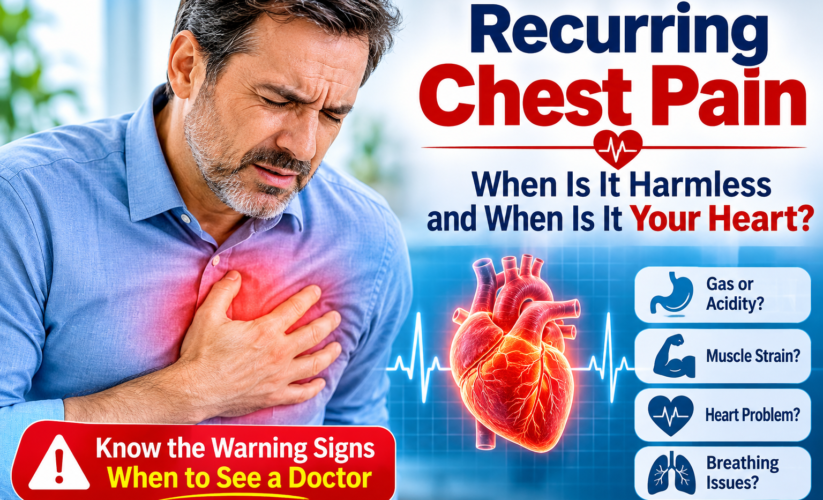
Recurring Chest Pain: When Is It Harmless and When Is It Your Heart?
By allieduser
You are halfway through your day when a strange tightness shows up in your chest. It fades in a few minutes, so you carry on. Then it returns on Sunday, and again on Wednesday, and a quiet worry begins: what if this is my heart?
Almost everyone feels that worry the first time, and it is a sensible reaction. Chest pain is one of the most common reasons people walk into a clinic. Most causes turn out to be harmless, but a few are not, and the difficult part is that they can feel alike. This guide will help you read the clues your body is giving you, so you know when to watch and when to act.
Why does the chest hurt in so many different ways?
Think of your chest as a crowded shared flat. The heart, lungs, food pipe, ribs, muscles and nerves all live side by side, and when one of them complains, the neighbours often feel it too. That is why the chest pain causes range from a pulled muscle to a blocked artery, and why the spot where it hurts never tells the full story.
What helps far more is the pattern. Notice when the discomfort starts, what you were doing, how long it stays and what makes it better or worse. Those four details are often the first thing a doctor wants to hear.
What are the warning signs doctors look for?
The chest pain symptoms that worry doctors most are not the sharp, passing stabs. They are the ones that feel heavy, squeezing or tight, last longer than a few minutes, or arrive along with other changes in the body.
Does it matter which side it hurts?
Many people ask about chest pain on left side because the heart sits slightly to the left. A heart problem can certainly cause pain there, but so can gas, a strained muscle or irritated rib joints. Left-sided pain is not automatically a heart issue, and it is not automatically harmless either.
Chest pain on right side worries people less, yet it deserves attention as well. Acid trouble, gallbladder problems, muscle strain and lung conditions can all sit behind it, and a heart problem can occasionally show up on the right too. The side alone can never settle the question.
Is it just gas or acidity?
Plenty of people have felt chest pain due to gas: a sharp, crampy ache that shifts around, eases after burping or passing wind, and does not get worse when you walk.
Acid reflux is another very common culprit. When stomach acid creeps up into the food pipe, it creates a burning feeling behind the breastbone, which is why chest pain due to acidity is often described as a fire rising from the stomach. It usually brings a sour taste or burping, and it gets worse when you lie down.
Timing can offer a clue as well. Chest pain after eating is often linked to reflux, a heavy meal or trapped gas. But if the discomfort after a meal shows up mainly when you hurry or climb stairs, mention that to your doctor, because the heart can occasionally be involved.
Here is the catch. Early heart trouble can feel very much like indigestion. If your “gas problem” keeps returning, ignores antacids, or comes with sweating or breathlessness, please stop treating it at home and get it examined.
What if it is a muscle or breathing problem?
Picture someone who spent the weekend shifting furniture and now feels a sharp ache whenever they twist, stretch or reach for something. Muscle and rib strain usually hurts more when you press on the spot or move your arm, and it settles with rest. Heart-related discomfort generally does not change with pressure or movement. That is a useful hint, though not a guarantee.
If the pain sharpens every time you take a deep breath, you may notice chest pain when breathing. Irritated rib muscles, a chest infection or inflammation around the lungs can do this, and it is worth getting examined, especially if it began suddenly or comes with fever or cough.
Some people feel chest pain while breathing only in certain positions, such as bending forward or lying on one side. That often points to the muscles or the lining around the lungs. But a sudden, severe onset with breathlessness can signal a blood clot in the lung or a collapsed lung, and that needs urgent care.
Pay extra attention when the pain arrives together with chest pain and shortness of breath. That combination can mean a heart problem, a lung problem or a clot, so it is not something to wait out at home.
What does heart-related discomfort feel like?
Not like the movies. True heart pain is rarely a dramatic stab. It is more often a deep pressure, a heavy weight or a band tightening, and it may spread to the left arm, shoulder, neck, jaw or back.
When doctors assess heart pain symptoms, they look at the whole picture: how long it lasts, whether effort brings it on, and whether rest relieves it. A discomfort that settles within minutes of sitting down and returns with effort is a classic clue.
When the heart muscle does not get enough blood, the result is called angina chest pain. It is a warning that the arteries supplying the heart may have narrowed, and it should never be ignored simply because it passes.
The usual angina symptoms are a squeezing or heavy feeling, tiredness, breathlessness, nausea and discomfort that spreads to the arm, jaw or back. Stable angina eases with rest. If it begins to appear at rest, lasts longer or becomes more frequent, it needs prompt medical attention.
Many people do not call it pain at all. They say chest tightness, as if their shirt has suddenly become too small. Describe it to your doctor in exactly those words, because the way you describe a feeling helps in finding its cause.
Others talk about chest pressure, like a hand pressing down on the breastbone or someone sitting on the chest. Pressure that builds with effort or lasts several minutes should be checked without delay.
Should you worry when it starts with activity?
A very common pattern is chest pain during exercise. The heart works harder when you jog, lift weights or play a sport, and if the arteries are narrowed, it may not receive enough blood. Stop what you are doing if it appears, rest, and get evaluated before going back to heavy workouts.
Imagine someone who climbed two floors easily last month and now has to pause halfway. Chest pain while walking or climbing, which eases within minutes of rest, suggests the heart is asking for more blood than it is getting. Please do not wait for it to get worse before acting.
And what about the night?
Night makes everything feel louder. Acid flares when you lie flat, and anxiety tends to speak up when the house is quiet, so a lot of night-time discomfort is harmless. Still, chest pain at night that wakes you from sleep, or comes with a cold sweat or a sudden sense of dread, should never be brushed aside. The heart does not only misbehave in the daytime.
Which other symptoms change the picture?
If the pain arrives with light-headedness, fainting or a spinning feeling, that is chest pain and dizziness, and it may mean the heart is not pumping well or the blood pressure has dropped. Sit or lie down and call for help.
A cold, clammy sweat with no obvious reason, such as heat or exertion, is another red flag. Chest pain and sweating together are a recognised warning sign of a heart attack, so treat it as an emergency.
Some people, women in particular, feel sick or actually vomit. Chest pain and nausea can be mistaken for food poisoning or a stomach bug, which is exactly how heart attacks sometimes get missed.
Can stress and anxiety really cause it?
Yes, and more often than people expect. During a panic attack the heart races, breathing turns shallow and the muscles around the ribs tighten, which can feel frighteningly like a heart attack. Many people search for this as chest pain anxiety, and it is real pain, not imagination.
The sensible order, though, is heart first and anxiety second. Once a doctor has checked your heart and found it healthy, working on stress, sleep and breathing habits can bring genuine relief.
How do you recognise a heart attack?
Knowing the heart attack symptoms can save a life, yours or someone else’s. Look out for pressure or heaviness lasting more than a few minutes, pain spreading to the arm, jaw, neck or back, sudden breathlessness, cold sweat, nausea, light-headedness, or an overwhelming feeling that something is badly wrong. Women, older adults and people with diabetes may feel unusual tiredness, upper-back discomfort or something like indigestion instead.
Emergency warning: If the pain is severe, lasts more than 10 to 15 minutes, or comes with sweating, breathlessness, fainting or spreading to the arm or jaw, call your local emergency number or reach the nearest hospital right away. Avoid driving yourself, and do not wait to see whether it passes.
Not every heart problem begins with pain. Slow-building heart disease symptoms include getting breathless during activities you managed easily before, swollen ankles, palpitations, unusual tiredness and falling stamina.
In the same way, the list of heart problems symptoms also includes an irregular heartbeat, fainting spells and persistent fatigue, even when there is no pain at all. Tell your doctor about these too.
When is it time to see a heart specialist?
Wondering when to see a cardiologist? Book a visit soon if the pain keeps returning, appears with effort, began after the age of 40, or if you have high blood pressure, diabetes, high cholesterol, a smoking habit, excess weight or heart disease in your family.
A cardiologist is a doctor who specialises in the heart and blood vessels. You do not need to be sure it is your heart before you go. If the cause turns out to be acidity or a strained muscle, you leave with answers, and that peace of mind is worth the visit.
What tests will you be asked to do?
It begins with a conversation. Your doctor will ask when the pain began, how it feels and what brings it on. A quick ECG, which records the heart’s electrical activity, is usually the first step and takes only a few minutes.
After that, depending on what the doctor finds, you may be advised blood tests, an echocardiogram, a treadmill stress test or other scans. Not everybody needs every test. They exist to guide treatment, not to alarm you.
How is it treated?
Because the cause decides everything, chest pain treatment is never one-size-fits-all. Reflux improves with food changes and medicines, and a strained muscle recovers with rest and gentle care. Narrowed or blocked arteries may need regular medicines, lifestyle changes and, in some cases, a procedure such as angioplasty or bypass surgery.
The one thing to avoid is guessing. Taking painkillers or antacids for weeks on end can quietly hide a heart problem that needs proper attention.
What can you start doing today?
Small habits add up. Walk regularly if your doctor says it is safe, eat less fried and salty food, quit smoking, keep your blood pressure and sugar in check, sleep well and make some room for stress relief. It also helps to jot down the date, time and situation each time the pain appears. That simple diary can make your doctor’s job much easier.
Questions people often ask
Is occasional pain in the chest normal?
A brief pain that clearly follows a muscle strain or a heavy meal may be harmless. Pain that repeats without an obvious reason is worth a check-up.
Can a normal ECG rule out heart disease?
Not always. An ECG done when you have no symptoms can look normal even when the arteries are narrowed, which is why doctors sometimes suggest further tests.
Is left-sided pain always the heart?
No. Many non-heart problems cause pain on the left, and heart-related discomfort can be felt in the centre or on the right too. The side alone cannot settle it.
One last thing
If your pain has become a pattern, take it as a sign to act, not to wait it out. Most causes are manageable, and if the heart is involved, early attention gives you the best chance of staying well. Call your doctor this week, and keep the emergency signs above in mind until then.